How I Make Decisions
Indecisiveness has cost me a lot of anxiety and time. These are the questions and frameworks I reach for, chosen because they’re memorable enough to use in the moment.
Should I just trust my gut?
Use Spencer Greenberg’s FIRE framework. Trust your gut when the decision is:
- Fastthere’s no time to deliberate
- Irrelevantthe stakes are low
- Repetitiousyou’ve made this kind of call many times and gotten feedback
- Evolutionaryit’s the kind of thing our instincts evolved for
Otherwise, slow down and use the tools below.
Unsticking analysis paralysis
- If you had to act today, what would you do?
- How would you advise a friend on this question?
- Will this matter in five years?
- What’s the worst that could happen if you make an imperfect choice?
Big decisions: the WRAP process
From Decisive by Chip & Dan Heath. Every decision goes through four stages, and each stage has a typical villain. WRAP is the counter to each:
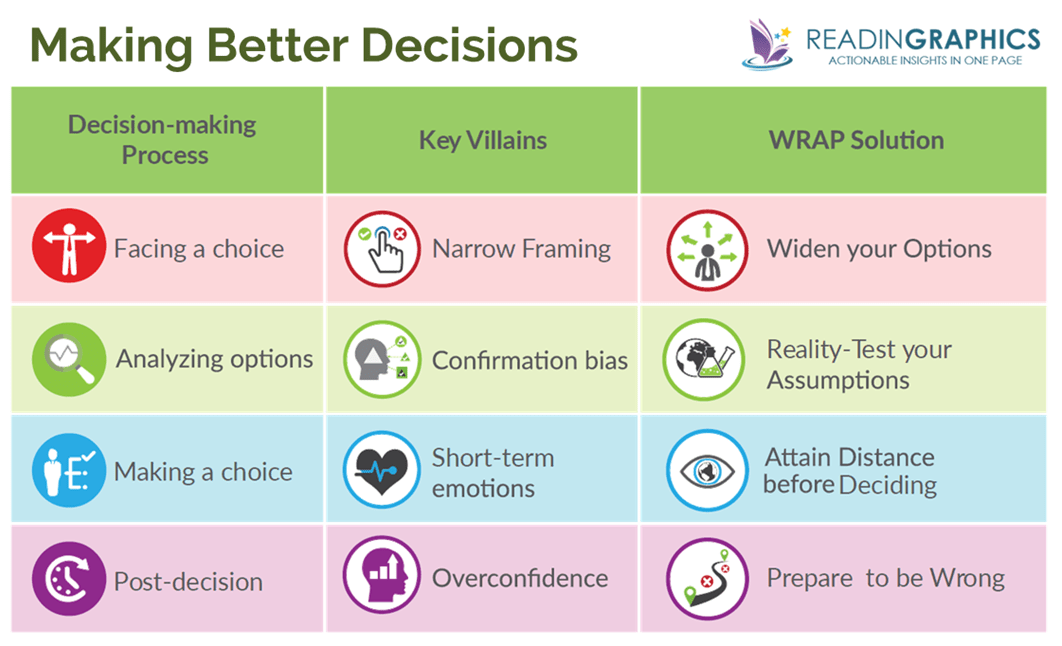
W: Widen your options
Villain: narrow framing, e.g. only seeing “whether or not.”
- Multitrack: think AND, not OR.
- Find someone who’s solved your problem, or a similar one, and ask them.
- Ladder up: look for local bright spots, then best practices, then cross-domain analogies.
R: Reality-test your assumptions
Villain: confirmation bias toward an option you already like.
- Ask disconfirming questions: “What problems does this approach have?”
- Zoom out: look at the base rate.
- Zoom in: sample the reality up close.
- Ooch: run small real-world experiments to address the uncertainties.
- For each option, ask: what would need to be true for this to be the best option?
A: Attain distance before deciding
Villain: short-term emotion, like anxiety, fear, or attachment.
- Personal: what would you tell your best friend to do?
- Professional: what would your successor do?
- How will you feel about this in 10 minutes, 10 months, and 10 years?
- Clarify your core priorities, so auxiliary ones don’t distract you.
P: Prepare to be wrong
Villain: overconfidence about how it will turn out.
- Premortem: it failed. Why?
- Preparade: it succeeded. What made it work?
- What would make you reconsider the decision?
- Set tripwires that trigger a re-evaluation.
Evaluating a single opportunity
- If FIRE: trust your gut. It’s either a hell yeah or a hell no.
- Otherwise: does it pay back more than it costs? Brendon Burchard’s version: the time, energy, resources, money, and sanity you put in should be less than the total return, counting not just money but relationships, future value, personal development, and lifestyle.
Doubting a decision I already made
- If FIRE: trust what your gut says.
- Otherwise:
- Write down a list of your uncertainties (time-box to 10 min).
- Answer the ones you can.
- Write down people who could help (time-box to 10 min).
- Write the message to them (time-box to 10 min).
If you want to act but something in you resists, see emotional resistance.
Further reading
- Decisive by Chip & Dan Heath, and my review of it
- The book’s companion resources: the Decisive Workbook, which summarizes the book well, and 12 Decision Situations, which applies WRAP to twelve distinct situations
- The FIRE framework, by Spencer Greenberg