Emotional First Aid Guide
In-the-moment tactics for strong emotions like overwhelm. Try them and see what works for you.
Right now
- Sigh it out. Two inhales through the nose, a deep one and then a short top-up, followed by one long, slow exhale through the mouth. Do it 1–3 times.
- Find your body. Where do you feel this: face, throat, chest, stomach? Name the sensation (tight, hot, heavy) and let the story about it go for now.
- Ground. Name 5 things you see, 4 you hear, 3 you can feel, 2 you smell, and 1 you taste.
Still intense? Shake it out for a minute, then find the feeling under Inner states.
The rest of this page is a reference. For longer-term, strategic exercises, see Emotional Regulation Playbook. Also see my CC Inspirational Collection.
Silver bullets
Somatic wheel
Adapted from Vlad Moskovski’s frameworks one-pager.
For gaining clarity before or after any intense situation or decision:
- Slow (breathing, talking)
- Sense: scan your face, shoulders, throat, chest, and stomach. Notice tension, temperature, heaviness, constriction.
- Name the physical sensations. Notice and let pass: emotions, thoughts, stories.
- Choose: act with intention.
Nervous system regulation exercises
Try these:
- Physiological sigh
- Two consecutive inhales through the nose: a deep breath followed by a shorter, sharp breath
- followed by a long, slow exhale through the mouth
- Repeat 1–3×
- Alternate nostril breathing
- Sit comfortably.
- Use your right thumb to close the right nostril and inhale through the left.
- Then use your ring finger to close the left nostril and exhale through the right.
- Inhale right, then exhale left.
- Repeat 3×
- Voo-hum breathing
- Voo breathing (foghorn): take a deep belly breath, then exhale slowly while making a low-pitched, vibrating “voooooo” sound from the belly, like a foghorn. Do 3×.
- Hum breathing: take a deep belly breath, then exhale with a “hum” sound. Do 3×.
Nervous System Mastery with Jonny Miller
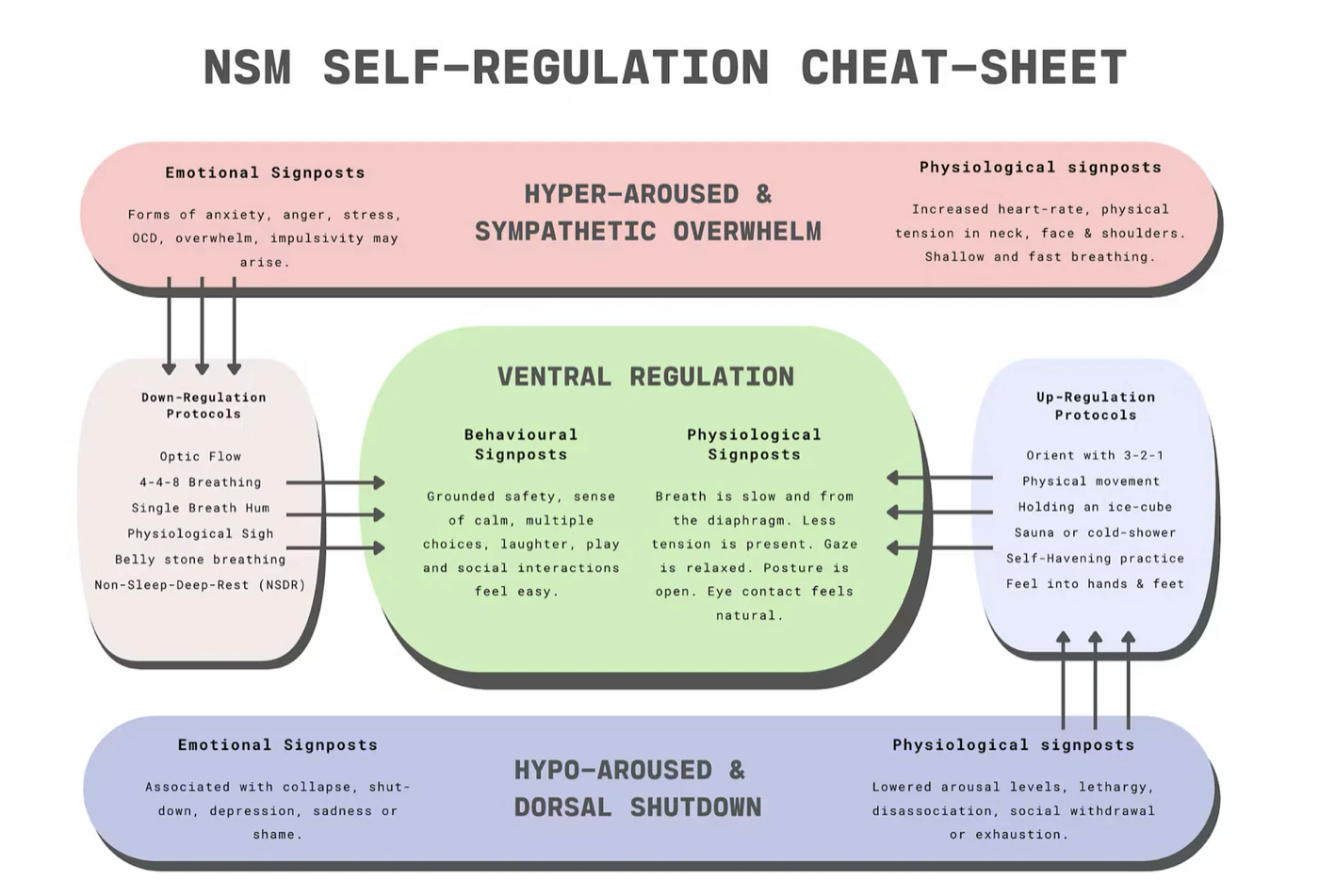
More protocols from the course, each as a step-by-step card:
- Alternate nostril breathing (3-3-6): for a racing mind, or at bedtime
- Optic flow: soft, wide gaze, for after a long stretch of screen time
- Belly breathing into the floor: for panic
- Neck self-massage: pairs well with voo-hum
- 3-2-1 orient: three things I see or hear, two I feel, one deep breath
- NSDR (non-sleep deep rest): free guided ones from Ally Boothroyd (25 min) and MadeFor
If this, then regulate. A trigger-action plan can use a state as its trigger: “If my mind is racing at bedtime, then five minutes of alternate nostril breathing.”
When I’m flat
Everything above calms things down. Sometimes the problem is the opposite: foggy, heavy, numb, running on empty. That’s the hypo-aroused side of the cheat-sheet. Sitting still and waiting for it to pass tends to keep me there. What brings me back is safe movement or sound.
- Move, gently: a walk, a swim, shaking out my arms and legs, neck self-massage.
- Make a sound: humming, or voo breathing.
- Breath of fire
- Sit up. Breathe out sharply through the nose, about once a second, and let each inhale happen on its own.
- About 30 of those. Then breathe all the way out and hold, for as long as it’s comfortable.
- Rest for 30 seconds. One to three rounds.
- Finish with something calming, like a physiological sigh, so I land steady rather than wired.
- Stop if I get dizzy. Skip it if pregnant, or with heart, blood-pressure or breathing problems (like asthma).
Protocols from Jonny Miller’s Nervous System Mastery course, in my own words.
More techniques
- Depression / anxiety
- Emotional release: shake it out!
- Tony Robbins UPW 2023 exercise (40 min)
- Overwhelm
- Art of Accomplishment episode on overwhelm: “What’s actually happening on an emotional level is there are all these big emotions and you are not feeling them. You are not allowing them to pass all the way through you, so your system is overwhelmed with the amount of emotions you have.”
- Identify the emotions, isolate them, and let each pass through you.
- DBT
- STOP: Stop (freeze completely), Take a step back, Observe, Proceed mindfully.
- Opposite action: do the opposite of what the emotion suggests.
- More ideas: 21 methods to calm yourself down (BetterUp)
Inner states
- Lack of motivation → meditate, then step into your Circle of Excellence
- Anxiety → say “I’m excited!” out loud 10 times (with arm motions!)
- Deeper: identify what you’re excited about in the situation (e.g. a growth opportunity, a new perspective), and say “I’m excited” 10 times after each reason!
- How it works: anxiety and excitement share neural circuits.
- Source: Art of Accomplishment (Joe Hudson) workshop “Embracing Intensity”.
- Fatigue → how to feel energized instantly
- Swing your arms together (parallel to the ground) into a quick clap, 10×.
- Bonus points if you also look upward and smile as widely as you can.
- Fear
- Emotional access: savor the fear.
- Emotional release: literally lie on the floor and shake.
- To listen: 7 Powerful Questions to Stopping Fear and Anxiety
- Shame → find a quiet place and cry, or book an ecstatic dance
- Guilt → get specific about what you feel guilty for, then turn it into what you’ll do differently
- Anger → create a container for it to happen (dissipate, not vent)
- Apathy → review getting more done, faster
Emotional baggage: unfelt emotions
- Shock (not anticipated, a sense of denial) → get back into your body, breathe
- Sadness / depression → a totally normal signal
- Longing → say “this is part of it”
- Rumination → let it pass
Practices
Sitting with it
- Urge surfing: a technique from addiction counseling for processing impulses.
- E.g. the impulse to grab a snack, check your phone, or stare at the wall.
- Feel the urge, be present with it, hold space, breathe.
- Like a wave, the urge will intensify at first. Eventually it will peak, and eventually it will dissipate.
- Eugene Gendlin’s Focusing
- Classic six steps: 1 Clearing a space · 2 Felt sense · 3 Handle · 4 Resonating · 5 Asking · 6 Receiving
- Guided: the Focusing audiobook
- Core Transformation: an overview
Getting unstuck
- Resolve cycles: ten minutes to unblock yourself.
- Write down your problem.
- Set a timer for five minutes and free-write possible solutions.
- Set a timer for five minutes, identify the action item, and execute.